
Flexible by Design: How Tempco Silicone Rubber Heaters Solve Heating Challenges Across Industries
Not every heating problem calls for a rigid solution. Many industrial applications involve irregular surfaces, tight footprints, weight-sensitive assemblies, or geometries that simply don’t accommodate conventional heaters. That’s where Tempco’s silicone rubber heaters consistently prove their value. Thin, lightweight, and built to conform, they deliver precise, reliable heat in exactly the locations and configurations that other heater types cannot.
Two Constructions. One Versatile Platform
Tempco offers silicone rubber heaters in two distinct element constructions, each suited to different production and performance requirements.
Wire-wound heaters use a resistance wire wound on a fiberglass cord for support and flexibility. The element is laid out in a carefully designed pattern to ensure a uniform heat profile across the heater surface, accommodating holes, cutouts, and concentrated heat zones as the application requires. Wire-wound construction is the preferred choice for production quantities from a single unit up to a thousand or more, heater sizes ranging from 2” x 2” to as large as 20” x 144” have been produced by Tempco, and prototyping work where validating design parameters before committing to high-volume production is important.
Etched foil heaters use a thin nickel-base alloy foil (.001″) as the resistance element. The resistance pattern is designed in CAD, transferred to the foil, laminated to the insulating substrate, and processed through an acid spray to produce the final element geometry. Because the flat surface’s overall heated area is larger than that of a wound wire, etched foil heaters deliver more uniform heat profiles, higher watt densities, and longer operating life. They can also be zoned with distributed wattage or separate heating circuits to compensate for varying load conditions across the heater face. Etched foil is recommended for small heaters produced in large quantities.
Both constructions are rated for continuous operation up to 392°F (200°C) and intermittent use up to 500°F (260°C), and both are physically resistant to moisture, ozone, fungus, and radiation.
Built to Fit Any Surface or Configuration
One of the most compelling characteristics of Tempco silicone rubber heaters is the range of ways they can be configured and mounted. For flat or near-flat surfaces, pressure-sensitive adhesive (PSA) mounting offers simple, tool-free installation with a peel-and-stick application. PSA is recommended for continuous duty up to 300°F (149°C) at watt densities under 5 W/in², with intermittent capability to 500°F (260°C).
For permanent installations requiring maximum heat transfer, Tempco offers factory vulcanizing directly to bare or anodized aluminum, stainless steel, marble, and other hard surfaces. The uncured heater is placed on the metal component and processed in a vacuum oven where the silicone rubber flows into the micro-structure of the metal surface, forming an exceptionally strong, homogenous bond. The metal component can be manufactured by Tempco or supplied by the customer.
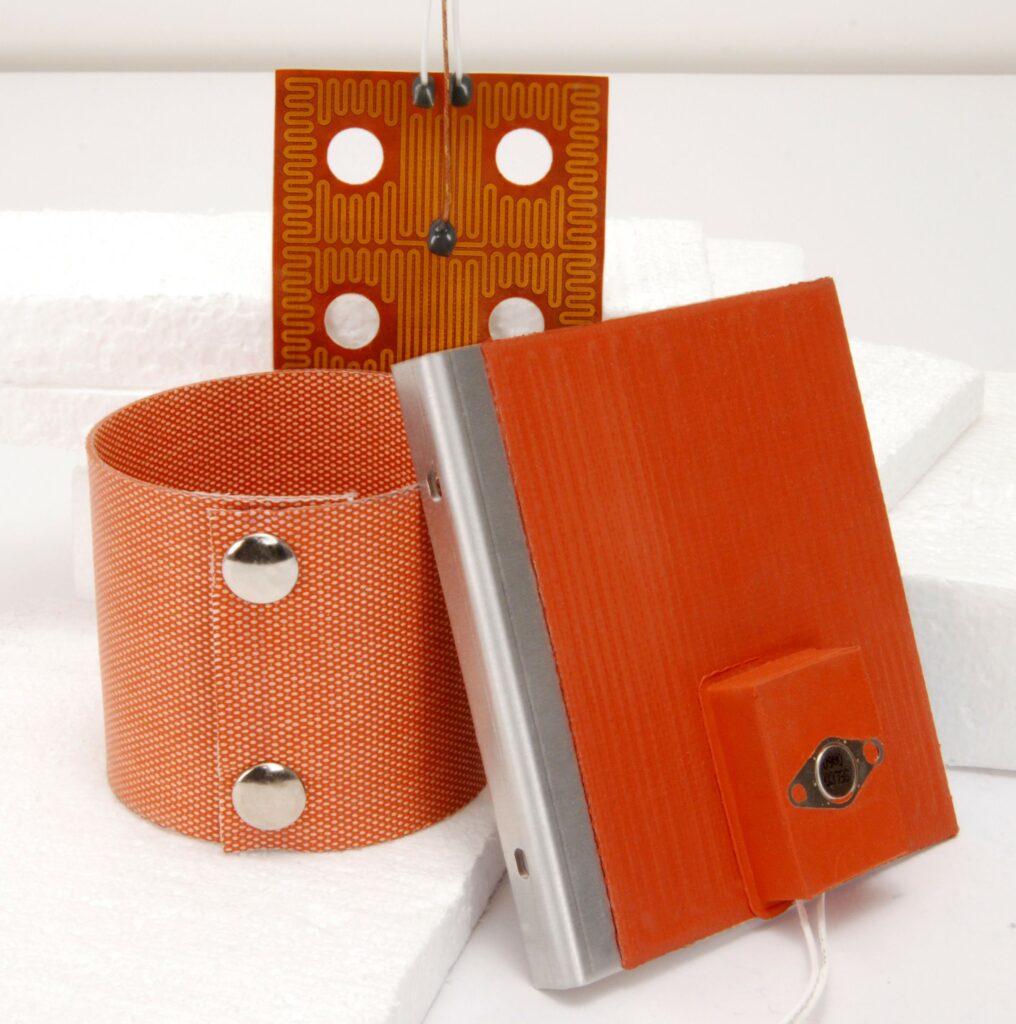
For cylindrical surfaces, Tempco has developed outside diameter mounting techniques for permanently attaching silicone rubber heaters to pipes and vessels ranging from 0.5 inches to 6 inches in diameter and up to 20 inches in length. Three-dimensional configurations can also be vulcanized to shaped outlines for wrapping around pipes or small vessels where flat heaters would leave gaps in coverage.
Applications where the heater must be removable are served by a full range of mechanical fastening options including D-rings and straps, Velcro straps, boot hooks and springs, grommets and lacing cord, snaps, and heavy-duty spring clamps. Magnetic mounting is also available for situations requiring quick attachment to steel surfaces, rated to 200°F (93°C) at a maximum watt density of 1 W/in².
Integrated Sensing and Control Options
Tempco silicone rubber heaters can be specified with temperature sensing and control hardware built directly into the assembly. Type J and K thermocouples can be incorporated at virtually any location on the heater surface. Platinum thin-film RTDs (100 ohm at 0°C, 0.00385 TCR/DIN 43760) are available in 2- or 3-wire configurations for applications requiring greater measurement accuracy. Thermistors can also be incorporated for systems where the control logic is designed around a specific sensor response.
For self-contained heating applications, snap-action thermostats with automatic reset are available with setpoints from 50 to 450°F in 10°F increments. Adjustable thermostats with user-accessible dial controls cover ranges from 50 to 425°F (10 to 218°C). High-limit protection can be added through snap-action high-limit thermostats with manual reset or through thermal fuses, which provide one-shot cutoff protection across a range of 151 to 464°F (66 to 240°C) in the event of a primary control failure.
Where Tempco Silicone Rubber Heaters Perform
The breadth of industries served by Tempco silicone rubber heaters reflects how broadly the design problem of heating an irregular, space-constrained, or weight-sensitive surface appears across industrial manufacturing. Current applications span aerospace de-icing systems, medical diagnostic and analytical equipment, semiconductor processing, food service and packaging machinery, automotive battery heaters, laboratory instrumentation, ATM machines, copy machines, vacuum chambers, vending equipment, and composite curing operations.
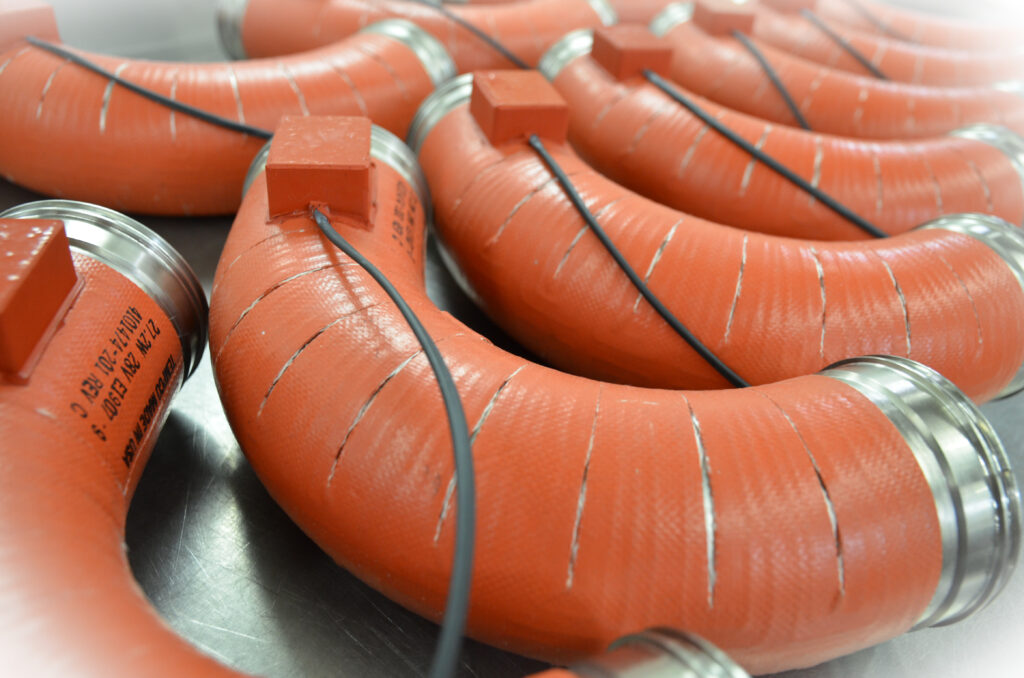
In composite manufacturing specifically, Tempco’s silicone rubber heater blankets are used to bond and cure composite structures where temperature uniformity across the part surface directly affects bond strength and finished part quality. The combination of flexibility, durability, and even heat distribution makes this product a natural fit for a process that demands consistent, controlled thermal profiles across complex shapes.
Specifying the Right Heater for the Application
Selecting the appropriate Tempco silicone rubber heater begins with the operating conditions: surface geometry, target temperature, duty cycle, watt density requirements, and the environment the heater will operate in. From there, the choice of element construction, mounting method, lead configuration, sensor integration, and any required safety controls follows logically from the application parameters.
Tempco’s engineering team works directly with customers throughout the specification process, from initial design through approval drawings, to ensure the heater configuration matches the installation requirements before manufacturing begins. Standard preconfigured part numbers are available for common heater sizes and configurations, and fully custom designs are accommodated for applications with unique geometries, wattage profiles, or environmental requirements.
