
High-Temperature Cartridge Heaters: Overcoming Failure in Industrial Heating Applications
An industrial equipment manufacturer was experiencing recurring cartridge heater failures in high-temperature heating applications. These systems required metal blocks to reach 660°C (1220°F) while maintaining temperature stability for processes such as heating dies and glue pots. The heaters operated at approximately 760°C (1400°F) to achieve the required block temperature. The manufacturer had been using cartridge heaters from another supplier, but failures occurred every eight to twelve months, disrupting production and creating warranty concerns. When they approached Tempco for a solution, engineering analysis revealed that the existing heater design and installation practices were not optimized for these extreme operating conditions.
Challenge
The manufacturer faced two distinct failure patterns. First, heaters occasionally failed catastrophically when the internal resistance wire reached its melting point, leaving equipment completely inoperative. Second, heaters failed at the lead wire termination area when temperatures exceeded the rating of the lead wire insulation. This failure mode caused intermittent operation or electrical shorts that were difficult to diagnose.
The application imposed demanding requirements. Blocks needed to heat from 50°C (122°F) to 660°C (1220°F) in approximately 15 minutes while maintaining temperature uniformity. Space constraints limited the number and size of heaters, creating pressure to use high watt density designs.
Analysis of failed units revealed significant oxidation and scaling on the 321 stainless steel sheath surfaces. Thermal calculations showed that the watt density required for the 15-minute heat-up specification pushed internal element temperature dangerously close to the nichrome wire melting point of approximately 1400°C (2550°F). At the bore clearances being used, heat transfer from heater to block was insufficient, causing internal temperatures to climb even higher.
Solution
Tempco’s engineering team addressed both failure mechanisms systematically. For the overheating issue, watt density calculations revealed that reducing heat concentration would lower internal temperatures. Rather than simply reducing total wattage and extending heat-up time, the solution used additional heaters with proportionally lower individual wattage distributed throughout the block.
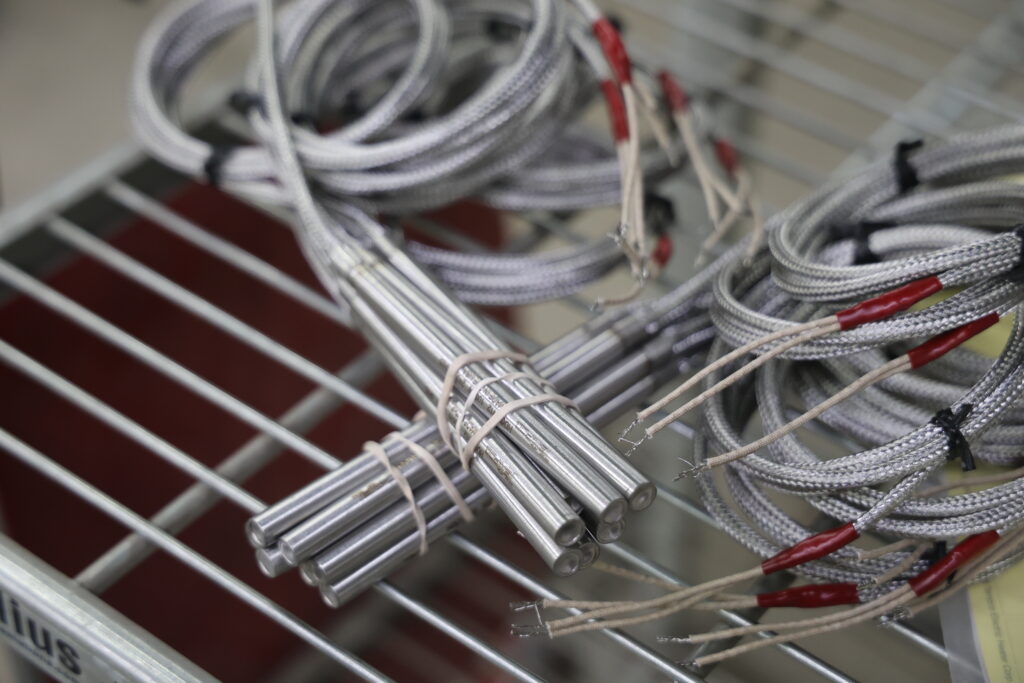
The original design used four cartridge heaters at 12.5 mm (1/2 inch) diameter and 203 mm (8 inches) long. The redesign specified six heaters of the same dimensions but with lower individual wattage, reducing watt density by approximately 35 percent while maintaining the required heat-up time. The distributed heating pattern also improved temperature uniformity.
Bore fit tolerance proved equally critical. Original holes measured 12.9 mm (0.506 inches) diameter, providing 0.4 mm (0.016 inches) clearance that simplified installation but significantly reduced heat transfer efficiency. Tempco recommended reaming holes to 12.70 to 12.73 mm (0.500 to 0.501 inches) diameter. This specification accounted for the heater’s actual maximum diameter of 12.60 mm (0.4965 inches) after centerless grinding plus a 0.08 mm (0.003 inch) maximum camber, resulting in minimum bore size of 12.70 mm (0.500 inches). The 0.025 mm (0.001 inch) reaming tolerance provided the precision needed for optimal heat transfer while allowing for practical installation.
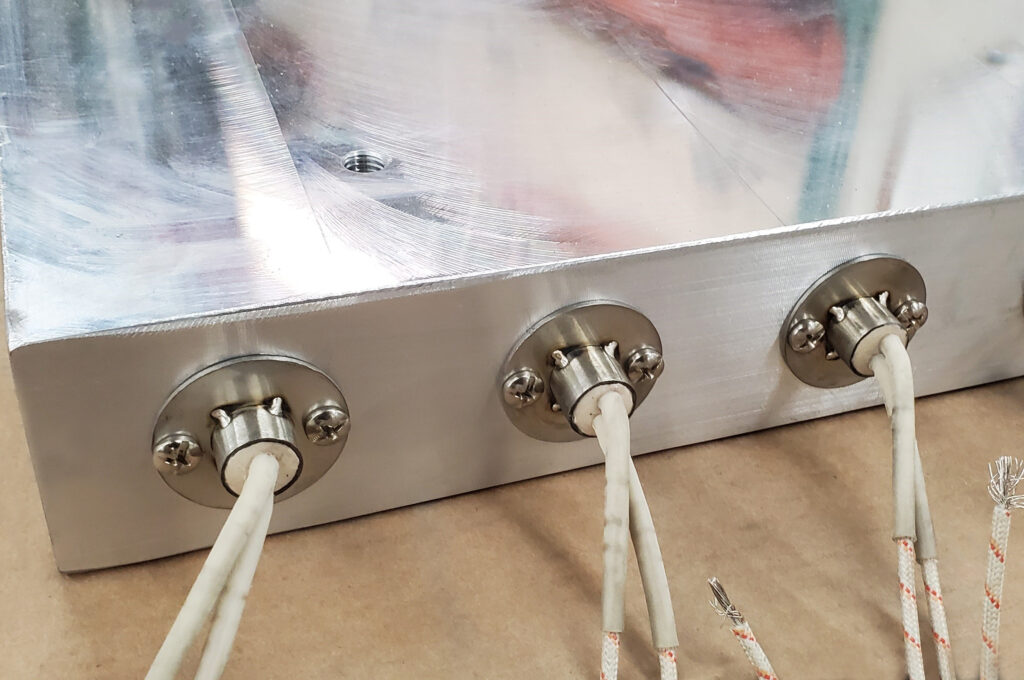
Centerless grinding the heaters to 12.45 mm plus or minus 0.013 mm (0.4960 inches plus or minus 0.0005 inches) was incorporated as part of the solution. This process reduced the normal heater diameter tolerance from plus or minus 0.05 mm (0.002 inches) to plus or minus 0.013 mm (0.0005 inches), enabling the tighter bore fit required for efficient heat transfer at extreme temperatures.
Material selection changed to Incoloy 800 sheaths instead of 321 stainless steel for superior oxidation resistance at 760°C (1400°F). This alloy forms a stable protective oxide layer that resists the scaling observed with stainless steel at extreme temperatures.
The lead wire termination problem required a different approach. Tempco designed heaters with a 25 mm (1 inch) unheated section at the lead end extending outside the heated block, keeping the termination area below the 250°C (482°F) rating of standard fiberglass insulation. Ceramic beads installed over the first 76 to 102 mm (3 to 4 inches) of nickel pins provided additional protection. Lead wires rated to 550°C (1022°F) gave extra margin against temperature excursions.
The solution also addressed heater removal challenges. At temperatures near 660°C (1220°F), heater sheaths oxidize and can bond into bores, making removal extremely difficult. Tempco incorporated a threaded removal bushing at the lead end of each heater, allowing technicians to extract heaters with a wrench without damaging the equipment.
Results
The redesigned heating system eliminated premature failures. Heater life extended significantly with no failures reported. Accelerated life testing simulated five years of typical use, including hundreds of thermal cycles. Post-test inspection showed minimal oxidation on Incoloy 800 sheaths and no lead wire termination degradation.
Temperature uniformity improved measurably. The distributed heating pattern reduced variation from ±10°C to ±5°C (±18°F to ±9°F) at 660°C (1220°F), enhancing process consistency. Heat-up time remained within the 15-minute specification despite lower watt density per heater.
The removal system proved valuable during maintenance. Service time for heater replacement decreased from approximately 90 minutes to less than 20 minutes, minimizing downtime and eliminating risk of damaging precision-machined bores. Warranty claims related to heater failures dropped to zero, and field reliability improvements strengthened the manufacturer’s competitive position.
Lessons Learned
Operating cartridge heaters near 760°C (1400°F) requires careful attention to details that matter less at moderate temperatures. Watt density becomes the dominant factor in longevity. Reducing watt density through larger heaters, longer heaters, or multiple lower-wattage heaters provides the most reliable solution.
Bore fit tolerance directly impacts heat transfer efficiency and internal heater temperature. At high operating temperatures, tighter fits become essential. Achieving bores reamed to 0.025 mm (0.001 inch) tolerance while accounting for heater camber and using centerless grinding to reduce heater diameter variation requires precision machining but delivers substantial performance improvements.
Material selection matters significantly at extreme temperatures. Incoloy 800 provides oxidation resistance that 321 stainless steel cannot match above 650°C (1200°F). Lead wire termination protection deserves explicit design consideration. Unheated sections extending beyond heated zones, ceramic bead insulation, and high-temperature rated lead wires work together to prevent difficult-to-diagnose field failures.
Planning for heater removal during initial design prevents maintenance challenges. Features such as threaded bushings represent small additions to manufacturing cost but eliminate expensive procedures required to extract oxidized heaters bonded into bores. With proper engineering and specification, cartridge heaters can perform reliably in demanding high-temperature applications.
