
Precision Where It Counts: How Tempco’s TPC Consoles Found a Critical Role in High-Performance Aerospace Manufacturing
Introduction
Not every new customer relationship starts with a request for a quote or a formal sales call. Sometimes the best ones start with a conversation at a trade show, a shared problem, and a question that almost nobody else can answer the right way.
That is exactly how Tempco came to supply precision temperature controllers to a major manufacturer of jet engine components for commercial aviation. The customer is among the most respected producers of jet engine components in the aerospace industry, supplying for some of the most demanding engine programs flying today. What they needed from Tempco was not complicated in concept. In execution, it was exacting in every respect.
The Challenge
The manufacture of turbine blades is one of the most technically demanding processes in industrial production. The blades are investment cast from nickel-based superalloys and built around ceramic cores that form the intricate internal cooling passages required for engine performance. Once the metal solidifies, those ceramic cores must be chemically dissolved in a caustic leaching bath without damaging the blade itself. The cleaning fluid used in this process must be held within a precise temperature range to work effectively. Too cold, and the chemistry stalls. Too hot, and the risk of compromising the blade material increases. For components that operate in some of the most extreme thermal environments in existence, there is no margin for imprecision.

What the production engineers required was a complete temperature controller assembly that could hold the bath within tight tolerances and accept their preferred input type accommodating a specific electrical connector they required on the rear of the unit. That last requirement had proven to be a sticking point with other suppliers.
The Solution
Three engineers from this aerospace company were walking the floor at the 2024 NPE show in Orlando when they stopped at the Tempco booth. A controller engineer at Tempco struck up a conversation, asking whether they had any temperature control needs. As it turned out, they did.
The discussion moved quickly from general to specific. The engineers described the application, the cleaning bath, the need for stable and accurate control in a pre-assembled enclosure and the input requirements their process demanded. Then came the question that had tripped up others: could Tempco place their special electrical connector on the back of the unit?
The answer came without hesitation. Absolutely.
That answer, and the confidence behind it, shifted the conversation. The engineers were speaking with a manufacturer that understood what custom truly meant, one that could build what was actually needed rather than what was simply easiest to produce. They were also struck by the fact that Tempco TPC controller products are made in America and does so at competitive prices, a combination that is not always easy to find.
The complete solution centered on Tempco’s TPC-2000, a self-powered, 2-zone control console built for true plug-and-play operation. The TPC-2000 draws heater power directly through its 15-amp line cord, switches the outputs via a fast-cycling solid state relay and provides an independent temperature sensor input for each zone, giving the customer simultaneous control over two process points within a single compact, benchtop-ready enclosure. Paired with the Tempco Model TEC-9400 as the controlling instrument, the system delivers the precision the application demands: fuzzy logic PID autotune, a 200-millisecond sampling rate, universal input configurable for thermocouples and RTDs, and bumpless transfer during failure mode to protect the process if a sensor fault occurs. It is an integrated, purpose-built combination, fitted with the customer’s specified connectors, and manufactured in America.
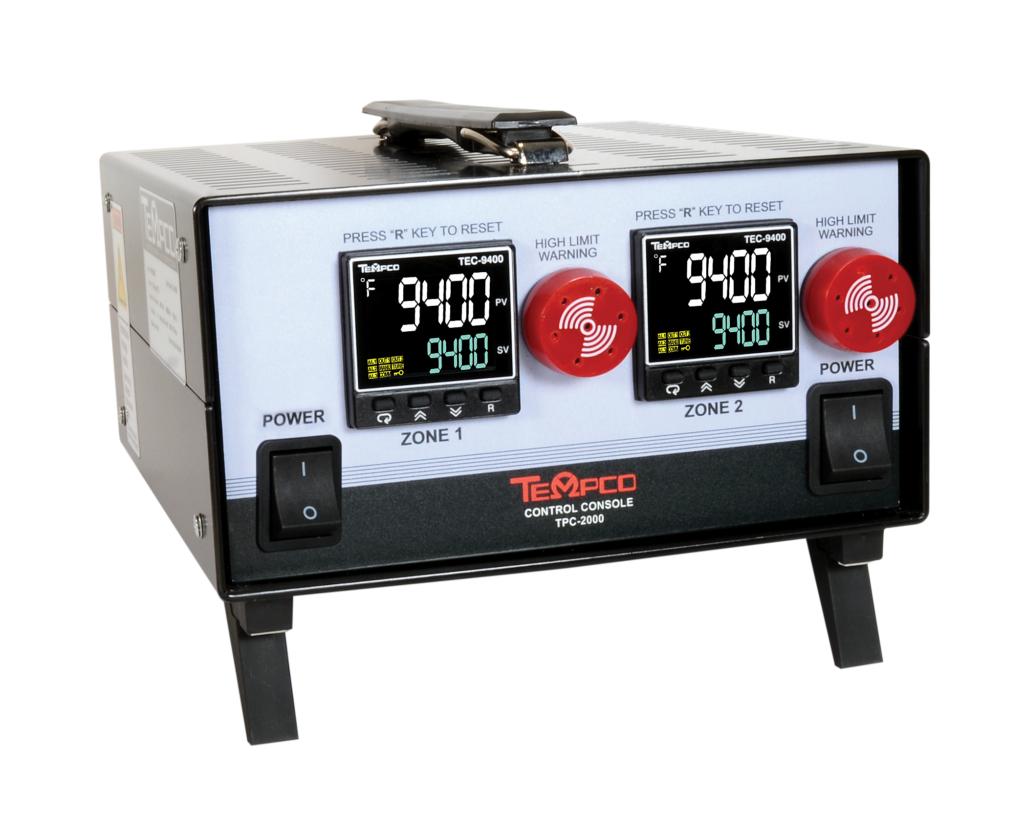
Fitted with the customer’s specified connectors on the rear of the unit, the TPC-2000 console was produced to the exact configuration the engineers had described.
The Result
The initial order was for a single unit, a reasonable starting point for any new supplier relationship, particularly in an industry where qualification and validation cycles are part of the standard process. Four months passed without contact. Then the customer resurfaced.
The follow-up order was for 18 units.
That kind of volume step-up says more about product performance than any promotional material could. The units had held temperature reliably, integrated cleanly into the customer’s system, and gave the engineering team the precise control they needed over a process where the stakes are measured in part quality and ultimately in-flight safety. That was nearly two years ago. All 19 units remain in service and have performed without issue since.
Lessons Learned
Trade shows remain one of the most productive environments for uncovering applications that would never arrive through a standard inbound channel. Three engineers walking a show floor were not looking for a temperature controller vendor that day. But they found one, because the right person asked the right question and the right person had the right answer ready.
Customization is not a niche capability at Tempco. It is central to what our company does. The ability to modify a standard product such as the TPC-2000 to accept a customer-specified connector, without lengthy lead times or cost premiums that eliminate the value of the solution, is precisely the kind of flexibility that builds long-term relationships in demanding industries.
And in aerospace manufacturing, where the components being produced operate inside jet engines carrying passengers at altitude, the requirement for precision is not merely a specification. It is an obligation. Tempco delivered on that obligation and continues to do so every day those units run.
