
This is a hypothetical, composite scenario developed for educational and product-demonstration purposes. It does not describe an actual Tempco customer, project, event, or measured result. No claims in this document should be attributed to, or represented as, a real installation. Every product specification referenced is real and drawn from Tempco’s published catalog.
THE SCENARIO
When an injection-molded part starts showing inconsistent surface finish or short shots, the melt-stream thermocouple is rarely the first place a maintenance team looks. It should be.
Consider a plastics processor running high-cycle injection molding across several presses. Melt temperature at the nozzle drives cycle timing and part consistency, and the process controller only knows what the thermocouple tells it. A probe that reads even a few degrees off, intermittently, doesn’t trip an alarm. It just quietly changes the part.
WHERE THE FAILURE MODE ACTUALLY COMES FROM
Melt bolt thermocouples sit directly in the plastic stream inside the barrel or nozzle, which is a mechanically hostile place: shear forces from the moving melt act on anything immersed in it. Tempco’s own melt bolt design guidance flags this directly: for the standard 1/8″ diameter probe, immersing the tip more than 1″ into the flow is not recommended, because the probe is prone to bending and breakage under melt-flow pressure at that depth.
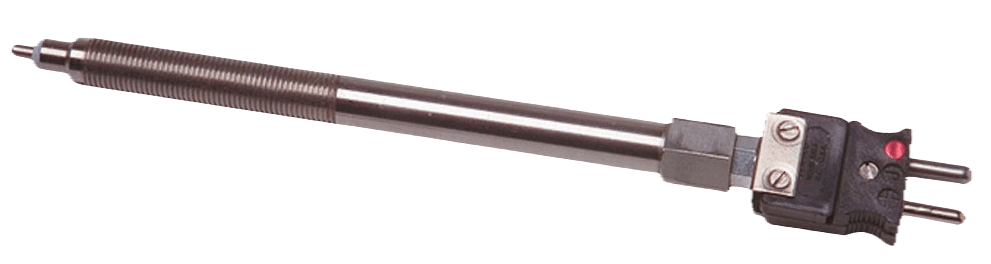
In a facility running several molds with different nozzle geometries, it’s easy to end up with an immersion depth that was right for one job and wrong for the next, especially if probes get swapped between presses without checking the tip length against the new nozzle. A bent or fatigued probe doesn’t always fail outright. It can keep producing a signal while contact with the melt stream degrades, which is a harder problem to catch than a clean failure, and a more expensive one, since it shows up as drifting part quality instead of a maintenance ticket.
THE ENGINEERING APPROACH
Tempco’s Style A Adjustable Tip melt bolt thermocouple is built around this exact problem. The tip is field-adjustable from flush to 2 inches, so a maintenance team can match immersion depth to the actual nozzle geometry at install time instead of stocking (or guessing at) a fixed length. The probe and 1/2-20 UNF mounting bolt are stainless steel, the sensing element is MgO-insulated, and the junction is closed-end grounded, with ANSI Type J calibration standard for the plastics-industry product line.
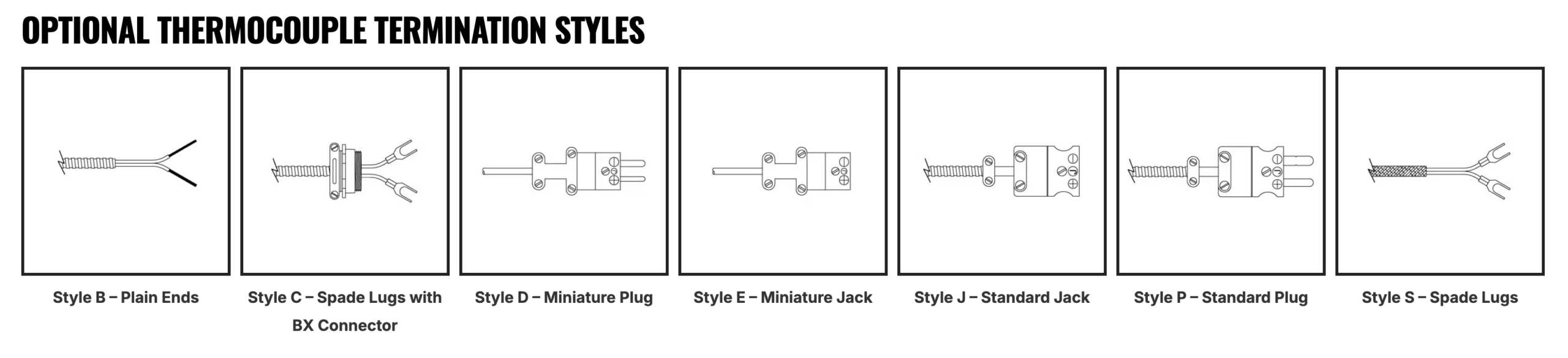
For zones where the 1″ immersion guidance is a real constraint, such as a nozzle geometry that calls for deeper immersion than a 1/8″ probe safely tolerates, Tempco also stocks the same design in a 3/16″ diameter. The added cross-section is expected to better resist the same bending load that affects the 1/8″ probe, though that reasoning is engineering logic pending confirmation rather than a spec stated on the catalog page. Fixed-immersion styles (rigid extension, flexible extension, or no extension) are available where field adjustment isn’t needed.
For the standard Style A, 1/8″ probe specifically, a Teflon® insert at the tip caps operating temperature at 500°F (260°C) maximum capability; consult Tempco for warranty terms before specifying sustained operation near that limit. Without the insert, the probe is rated to 1400°F (760°C) maximum capability. The same caveat applies there too: consult Tempco for warranty terms at sustained high-temperature operation.
WHAT THIS APPROACH IS DESIGNED TO DELIVER
- Matching tip immersion to actual nozzle geometry, rather than a generic default, is designed to reduce the specific bending and breakage failure mode Tempco’s own guidance flags for narrow-diameter probes at deep immersion.
- A field-adjustable tip reduces the number of fixed-length part numbers a maintenance team needs to stock and reduces the chance of an immersion-depth mismatch when a probe is moved between presses.
- Consistent ANSI Type J signal quality supports the melt-temperature accuracy the process controller depends on for repeatable cycle timing.
