
Beyond Plastics: How Cast-In Thermal Components Solve Heating and Cooling Problems Far From the Extruder
Not Every Cast-In Heater Lives on an Extruder
Ask most process engineers where cast-in heaters belong and the answer comes quickly: extruder barrels, die heads, blown film dies, and the downstream platens that keep plastics processing on temperature. That reputation is earned. It is also an incomplete picture.
The construction that holds a consistent melt temperature also solves problems that have nothing to do with plastic. Tempco designs cast-in thermal components for original equipment manufacturers (OEMs), research and development, life science, and maintenance (MRO) applications, and for cooling as well as heating.
Mike Gohmann, a Tempco Territory Sales Manager with more than 18 years in cast-in heating, has worked alongside Tempco’s engineering team on some of the more surprising projects. Four of them, along with a sampling of applications documented in Tempco’s own catalog, show how far the technology travels.
At a Glance
- A cast-in heater is a tubular heating element cast inside an aluminum, brass, or bronze body, so the element and the working surface form one solid piece.
- Stainless steel or Incoloy® tubing cast in alongside the element lets one component heat, cool, or do both.
- Aluminum 319 is rated to 700°F (371°C); bronze is rated to 1350°F (732°C), as published capability ratings.
- Uses outside plastics include wastewater aerator freeze protection, brake rotor assembly, food warming, and satellite thermal vacuum testing.
- Tempco builds cast-in components in-house, from pattern to final inspection, normally starting at one piece.
Why Cast-In Construction Travels So Well
A cast-in heater is a tubular heating element cast directly into an aluminum, bronze, or brass body, so the element and the working surface become one solid, conductive mass. In other words, the heat source is part of the part. For platens, Tempco notes this is a more cost-effective and reliable approach than drilling holes for cartridge heaters or clamping strip heaters to the back of a plate.
That single-piece construction is what lets the technology adapt. The element layout is engineered with computer design tools to shape the heat profile. Stainless steel or Incoloy® tubing can be cast in alongside the element when a process needs both heating and liquid cooling, the basis of Tempco’s liquid-cooled cast-in thermo-platens. Working surfaces are machined to the customer’s drawing, from the standard 125 RMS finish up to Blanchard grinding for extremely tight tolerance requirements.
Alloy choice sets the operating envelope:
| Casting alloy | Maximum surface temperature* | Thermal conductivity (BTU-in/hr-ft²-°F) | Maximum element watt density* |
| Aluminum 319 (standard) | 700°F (371°C) | 754 | 35 W/in² (5.4 W/cm²) |
| Aluminum 356 (optional) | 750°F (399°C) | 1160 | 35 W/in² (5.4 W/cm²) |
| Yellow brass (UNS C85700) | 1200°F (649°C) | 582 | 45 W/in² (7.0 W/cm²) |
| Bronze (UNS C95300) | 1350°F (732°C) | 437 | 45 W/in² (7.0 W/cm²) |
Size is rarely the limiting factor. Standard platen designs run up to 60 inches (1524 mm) wide and 72 inches (1829 mm) long, and cylindrical designs reach a 48-inch (1219 mm) inside diameter. Aluminum castings can weigh up to 600 pounds, and bronze and brass castings up to 300 pounds. Tempco’s cast-in heater elements can be UL recognized when specified at order.
*Maximum surface temperatures and watt densities are published capability ratings for each alloy and element. Actual operating limits depend on the application design, and warranty coverage is defined by Tempco’s standard terms and conditions of sale. Full details are in Tempco’s Cast-In Heater Specifications and Tolerances guide.
Four Applications From the Field
Wastewater Aerators: Keeping Motors From Freezing
Many utilities hold and treat wastewater, such as treated sewage or stormwater runoff, in outdoor ponds or lagoons before it can be safely released into rivers or the ocean. Aerators supply the water with oxygen, which speeds up the natural processes that break down pollution. The problem is winter. Tempco worked with a customer to embed cast-in heating components beneath the aerator motors to keep them from freezing.
Outdoor duty like this is where termination choices matter. Tempco offers moisture-resistant terminations and housings for cast-in heaters, including the Type MPR box: die-cast aluminum with a non-removable polyurethane gasket in the lid.
Brake Rotors: Heated Platens That Fuse Two Halves
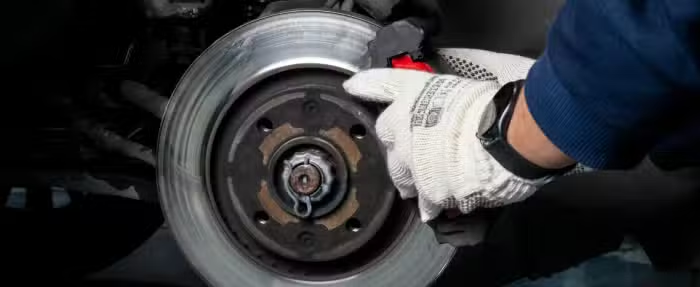
An automotive client used specialized cast-in heaters to assemble brake rotors. Heated platens positioned at the top and bottom of the two rotor halves compress and fuse them together, while the surrounding parts used to encapsulate the rotor shims are heated with Tempco cartridge heaters. Mike’s verdict on the platens: “a good fit not only for function, but durability.”
French Fry Warmers and Toaster Systems: Heat Through Direct Contact
Cast-in heating is common in food service equipment such as commercial toasters. Tempco was asked to produce cast-in platen heaters to sit under the bay that holds fries in restaurants and keep them warm.
The advantage is direct contact. “It gives a better heat transfer as the tray lays directly on top of the heater, instead of using tubulars that wind back and forth,” Mike said.

Food service designs often need more than heat. Tempco’s food service cast-in thermal components can include threaded studs cast into the aluminum body for mounting, cast flanges with machined O-ring grooves that isolate the terminal area in wash-down environments, moisture-resistant terminations for splash zones, and Teflon®-coated or electroless nickel-plated working surfaces where food may contact the casting.
Aerospace Vacuum Systems: Dense Castings for Satellite Testing
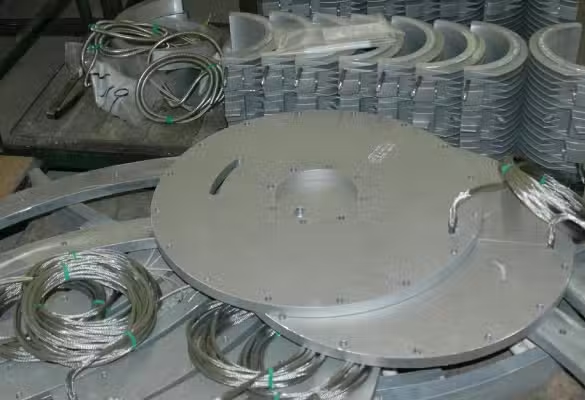
Tempco cast-in platens have been used in vacuum chambers for thermal testing of satellite systems. According to Mike, the deciding factor was construction: the dense, solid cast platens held up in vacuum, where more porous heating options risked shorting the elements or hurting performance in the chamber.
The four projects side by side:
| Application | Problem | What the cast-in design did |
| Wastewater aerators | Aerator motors freezing in outdoor lagoons | Heat beneath the motor, with moisture-resistant terminations |
| Brake rotors | Fusing two rotor halves during assembly | Heated top and bottom platens compress and fuse the halves |
| French fry warmers | Even holding heat under the fry bay | The tray sits directly on the heater instead of on serpentine tubulars |
| Satellite vacuum testing | Heat in a vacuum chamber without shorting | A dense, solid casting held up under vacuum |
More Places Cast-In Components Turn Up
Mike’s projects are not outliers. Section 3 of the Tempco catalog (pages 3-6 through 3-8) and Tempco’s Complex Geometric Thermal Components page document designs built for OEM and MRO customers well outside plastics. A sampling, grouped by the problem they solve:
Cooling Large Motors, and Braking Them
- A cast aluminum motor housing and base with integral liquid cooling for medium to large horsepower electric motors, originally developed and patented by Tempco (U.S. Patents 5,939,808 and 6,222,289).
- A cast-in thermal component that serves as a resistor for thermal dynamic braking of large electric motors.
Moving Oils, Adhesives, and Viscous Materials
- A bronze cast-in heater that maintains hydraulic oil temperature, and an oil pre-heater for industrial process equipment.
- A valve and flange heater that improves viscous material flow, a heater that lowers viscosity in glue processing, and a bronze heater for a mixer handling high-viscosity material.
- A cast-in heater for a melt pump.
- Cast-In Circulation Heaters for gases and liquids. The media flows through coiled, seamless 316 stainless steel tubing cast into an aluminum body and never contacts the heating element. The CHX-100 Series is rated for operating pressures up to 3,200 PSI and temperatures up to 650°F (343°C), with an optional cast bronze body rated up to 1,400 PSI at 1200°F (649°C). These are published capability ratings; actual limits depend on the application design.
Metalworking and Foundry Support
- A bronze cast-in heater for pre-heating salt baths.
- A system for pre-heating and mixing the chemicals used to make sand cores.
- A cast iron manifold heater for an aluminum low-pressure casting machine.
Laboratories, Life Science, and Hazardous Testing
- An electroless nickel-plated aluminum heater for an autoclave that sterilizes dental instruments.
- A heating and cooling cylinder for lab testing equipment, and a cast-in heater for heating beakers in a laboratory.
- An electroless nickel-plated bronze heater for equipment that tests nuclear hazardous waste.
Food, Packaging, and Converting
- An in-line system that pre-heats water to induce humidity in baking ovens.
- A heated feed nozzle for a candy processing machine.
- Bronze cast-in heaters for a package sealing machine and a laminating press.
- A heater used to adhere tax stamps to cigarette packs.
- An aluminum cast-in heater for the carpet mill industry.
Electronics and Semiconductor Processing
- Thermal platens for wave solder and reflow surface mount equipment that hold a temperature gradient of 5°F (2.8°C) across the entire working surface at process operating temperature, acting as both a radiant and a convection heat source.
- Wafer processing heaters, including pedestal heaters with or without integrated cooling, bake platen heaters, and high-temperature platens with interference press-fit tubular or cable elements. Options include hard-coat anodized surfaces, built-in temperature sensors, and working surfaces CNC machined flat to within 0.0005 inch (0.0127 mm).
The catalog also lists cast-in heaters in chemical processing, heat treating, hot melt dispensing, hot stamping, silk-screening, solvent reclaim, steam cleaning, and textile manufacturing equipment.
Built In-House, From Pattern to Final Inspection
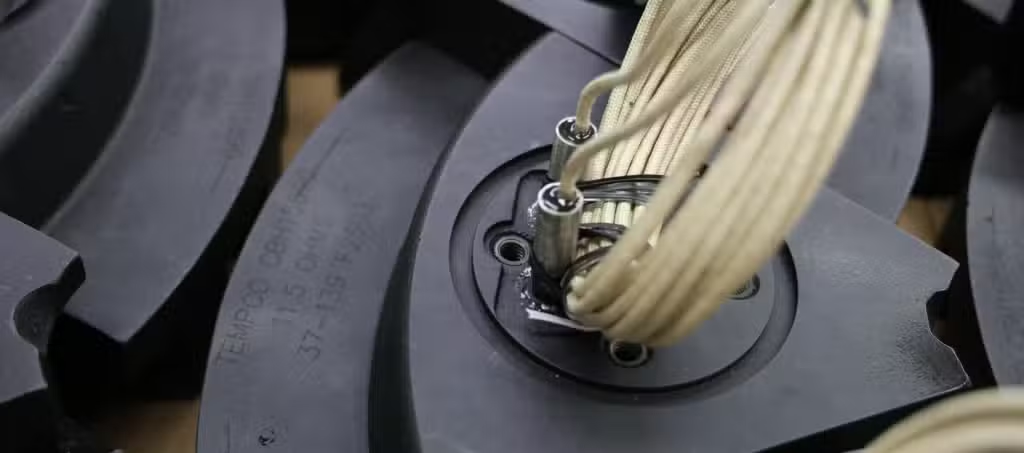
A one-of-a-kind cast-in component is only practical when the whole process sits under one roof. At Tempco, it does. Tempco’s engineers design each component with 3-D and CAD/CAM solid modeling, and Tempco manufactures the tubular and cable heating elements that go inside it.
The foundry matches the casting process to the job:
| Casting process | Best suited for | Alloys | Weight capacity |
| Low pressure | Large volumes and intricate geometries, with minimal machining | Aluminum | Up to 150 pounds, depending on shape |
| Tilt-pour gravity feed | Medium to high volumes, simple to moderately irregular shapes | Aluminum | Up to 150 pounds, depending on shape |
| No-bake sand molds | Low volumes, prototypes, very large irregular shapes, and thermal platens | Aluminum, brass, bronze, iron | Up to 600 pounds (aluminum); up to 300 pounds (bronze and brass) |
Electric reverb and induction furnaces minimize gas inclusion in the molten metal, producing a denser, higher-quality casting. An in-house pattern shop builds and maintains the wood and plastic patterns for sand molds, and Tempco machinists build and maintain the permanent mold tooling.
What cannot be cast to tolerance is machined. Tempco’s CNC machine shop handles simple to complex contours, turning, and boring, and a coordinate measuring machine (CMM) checks complex parts in process and at final inspection. Tempco’s lab services round out the picture: computerized infrared heating profiles, life cycle testing, heating ramp rate testing, 3-D solidification modeling, and X-rays that confirm heating element location and casting density.
That equipment earns its keep. Shaping a cast platen takes real engineering time to work out the shapes, cuts, and contours it needs, and some designs carry very specific machining tolerances that Tempco has the equipment to hold.
One Piece or a Production Run
Volume is not a barrier to starting the conversation. Even for projects that need only a few heaters, Mike encourages customers to contact Tempco to review the options and build a plan. In the rare event that Tempco cannot take on an order, the team will help find a partner that can.
“We don’t walk away from anything unless it’s absolutely outside of our capabilities,” he said. “Normally our minimum quantity is one piece.”
Tempco stands behind what it builds. Tempco products are warranted against defects in material and workmanship for one year from shipment, under Tempco’s standard Terms and Conditions of Sale. Before returning any product, contact your Tempco Territory Sales Manager to request a Returned Material Authorization (RMA).
To start a design, review Tempco’s Cast-In Heater Specifications and Tolerances guide, then send drawings with dimensions, critical tolerances, wattage, voltage, and any special requirements through Tempco’s Request a Quote page.
FREQUENTLY ASKED QUESTIONS
This blog was enhanced with updated information from a previous blog published on this site: LINK TO ARTICLE
