
Precision at Scale: Engineering Tempco’s Industrial Duct Heaters for High-Demand Applications
In industrial environments, the right heater matches the specific job requirements. Tight enclosures and precise tasks often call for compact inline forced air heaters that deliver targeted wattage within a small footprint. But when dealing with large air volumes, the situation changes significantly. Processes requiring substantial energy to heat significant airflow, whether for drying parts, curing inks, or burning off carbon emissions through pollution control, make duct heaters the preferred solution.
Designed for scale, Tempco’s duct heaters are commonly specified at individual capacities up to 45 kW. In a recent installation, four units were combined to provide nearly 200 kW of heating power, enabling the system to achieve and maintain the temperatures required for effective emissions abatement.
Built For Extreme Conditions
Every successful duct heater project begins with a thorough understanding of the application fundamentals. Tempco’s engineering team evaluates the starting condition of the air, its desired endpoint, and the volume of airflow involved. Critical factors include starting air temperature, target temperature, and airflow measured in CFM. These parameters set the boundary conditions for the entire design. From these inputs, the team calculates energy requirements, selects the appropriate element configuration and watt density, and develops a solution that meets performance, budget, and maintenance goals without overbuilding the system.
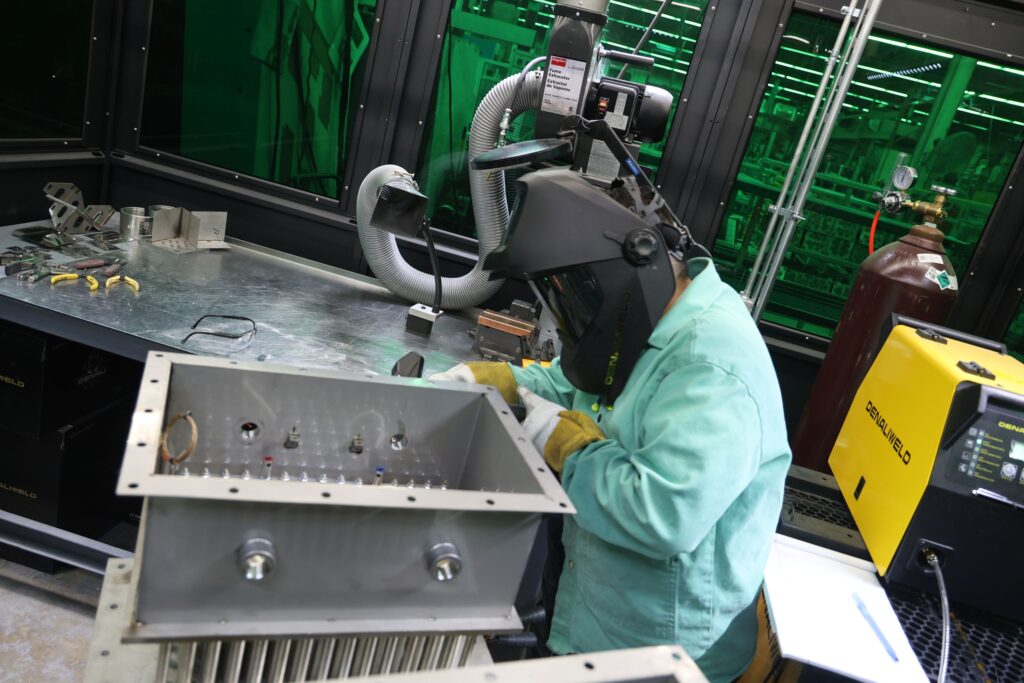
Some applications operate at the far end of the temperature spectrum. A recent emissions control project required outlet air temperatures ranging from 800 to 900°F before the airstream exited the facility. This specification demands more than simply adding elements; it alters the entire thermal dynamic of the assembly. While the airstream reaches 800 to 900°F, element sheaths operate in the range of 1,300 to 1,400°F, and internal coils can experience temperatures of 1,800 to 1,900°F.
Standard terminal layouts are not designed for such environments, even with wiring rated for 850°F. Tempco’s solution involves deliberately managing heat away from the terminal area. By extending the elements, creating intentional air gaps, and engineering thermal buffers, the team reduces operating temperature at the terminal box. The result is enhanced protection for critical electrical connections and extended service life under continuous duty.
This same emissions project introduced an additional and uncommon requirement for duct heaters: the system had to function under a positive back pressure of 2 PSI. In an exhaust path handling materials unsuitable for the workplace, any leakage is unacceptable. Traditional fabrication methods may yield satisfactory results at or near atmospheric conditions, but even minor weld imperfections that would be inconsequential at zero pressure can become problematic at 2 PSI. Recognizing this risk early in the design process shaped the entire quality plan for the build.
Custom Testing and Quality Control
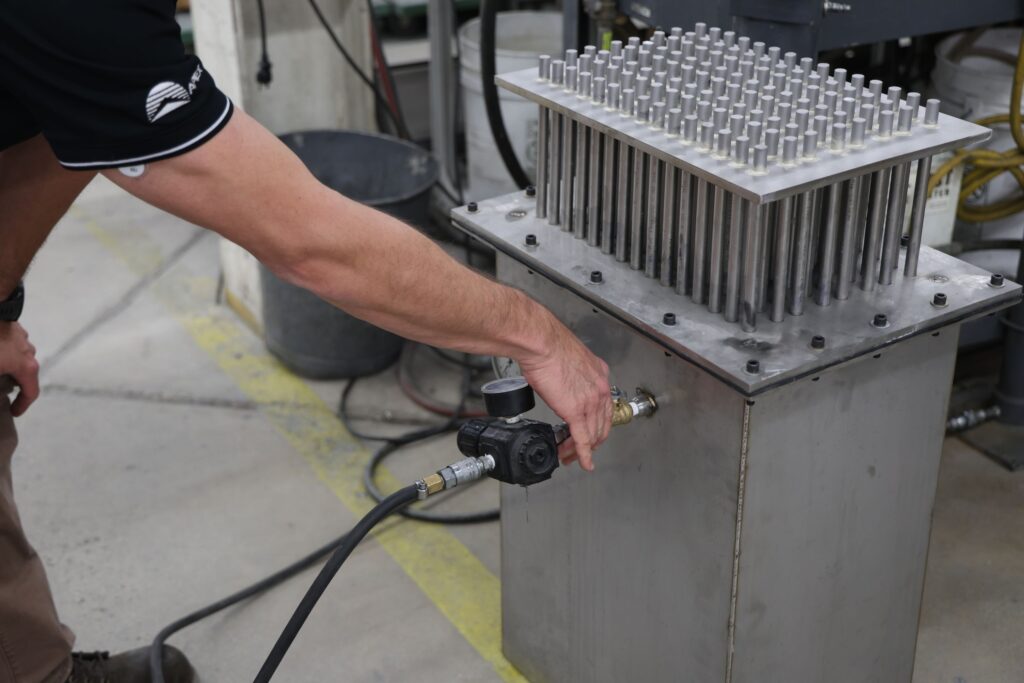
To eliminate uncertainty, Tempco developed a dedicated in-house pressure test for these assemblies. Using a custom closed fixture, each heater intended for pressurized service is tested at 5 PSI, well above the customer’s 2 PSI operating requirement. After the subframe is fabricated and the extension rods are cut and welded to the elements, the assembly is placed into the fixture before final assembly. If any issues arise, the team can address them while the heater remains open and accessible. This method confirms that welds are secure and that every assembly leaves the Tempco facility fully prepared to perform as specified.
Collaborative Design Evolution
Collaboration often distinguishes a design that functions on paper from one that operates effectively in the field. In one recent project, a 45 kW, 480 V heater with approximately 60 elements and a total draw in the 50-amp range required a two-circuit assembly for safe and efficient operation. The customer requested an integrated power distribution block to simplify their wiring, allowing a single three-phase power feed from the control panel rather than six separate conductors.
Tempco’s engineering team adjusted the layout to provide a mounting platform and increased the terminal box height to accommodate the block, whether supplied by Tempco or the customer. Final details were captured in approval drawings, ensuring both teams signed off on the configuration before manufacturing commenced. That step prevented change orders and kept the project on schedule.
Packaged Solutions for Emerging Applications
Tempco’s duct heater capabilities continue to expand alongside evolving customer needs. One program currently in development supports an automotive testing application with an airflow of approximately 1,300 CFM. The package will be delivered on a skid with an integrated control panel, providing a cohesive, installation-ready unit. This approach simplifies commissioning, accelerates startup, and gives the end user a single point of accountability for the entire system.
Engineering Discipline. Practical Results.
Whether the requirement is a four-heater array for pollution control operating at extreme temperatures or a next-generation packaged test system with integrated controls, Tempco’s process remains consistent. The team starts with real operating conditions, designs to the realities of heat transfer and airflow, builds to the appropriate standards for the environment, and verifies performance before equipment ships. That combination of engineering discipline and practical manufacturing expertise transforms specifications into reliable heating solutions, project after project.
